AI tools such as Microsoft Copilot, ChatGPT, and other generative AI solutions have rapidly become part of everyday business operations. They help speed up routine tasks, generate content, and even assist in strategic planning. However, surprisingly few companies yet have documented guidelines on how AI should be used responsibly, securely, and in a way that makes business sense.
In this article, we delve into why an AI policy is essential, what risks the use of AI can bring without rules, and how companies can build their own policy.
Do Companies Already Have AI Policies?
Yes – but only some.
According to Eurostat, in 2024, just under 14% of EU companies with at least 10 employees used AI in their business, showing an increase of 5.5 percentage points from 8% in 2023. In Finland, the adoption rate was the fourth highest in Europe: nearly 24% of companies used AI, an increase of about 10% from the previous year.
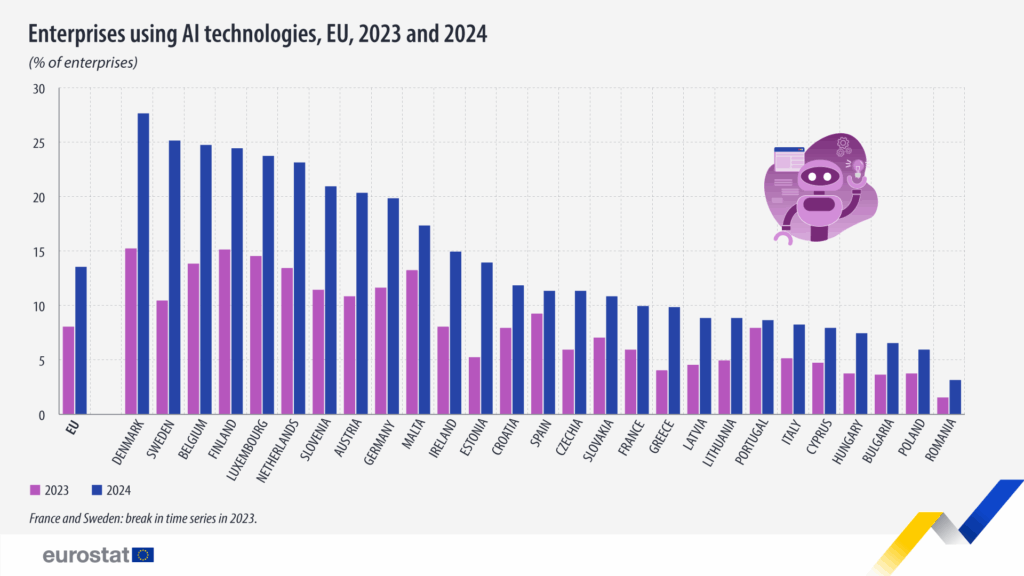
Source dataset: isoc_eb_ai, image: Eurostat
According to a study by ISACA, 83% of IT and business professionals utilize generative AI in their work, but only 31% of companies report having created a formal, comprehensive AI policy.
Large corporations, such as Microsoft, Google, and many financial and public sector actors, already have an AI policy or at least internal guidelines for AI use. In small and medium-sized enterprises, a policy may be completely missing or vague. “Use common sense” is not enough when talking about data security, ethics, or AI input data.
Why Is an AI Policy Important?
1. Data Privacy Is Easily Compromised
An employee might input customer data or trade secrets into an AI – without knowing where the data ends up for processing. If a protected organizational version, such as Microsoft 365 Copilot, is not in use, information can leak into external systems.
2. Unclear Liability
If an AI suggests incorrect content, who is responsible? The individual, the company, or the AI developer? AI suggestions must always be verified and used only with discretion – but without a policy, there is no guidance for this.
3. Uneven Skill Levels
Some have a broad understanding of how to utilize AI, while others have none at all. Without training and ground rules, differences in usage can arise, creating risks or wasting potential. Before using AI, it would be beneficial to undergo foundational training to help understand AI functionalities. For example, Kajaani University offers free basic AI training in collaboration with Microsoft.
4. Ensuring Regulatory Compliance
It is crucial for companies to develop their own AI policy to ensure compliance with the requirements of the EU AI Act. Its regulations affect data use and management, making an internal company policy essential. Each company is responsible for its own use and application of AI.
Utilizing AI is already quite easy and tempting for tasks like pre-screening job applicants from a large pool of applications. However, AI systems used for making recruitment decisions or decisions affecting them (e.g., automated pre-screening, ranking, or scoring of applications) are considered high-risk systems under the regulation, requiring a specific mode of operation.
The requirements of the regulation necessitate a systematic approach that a company’s own AI policy can provide. It helps the company avoid heavy administrative consequences and fines, which can amount to millions of dollars.
Copilot Is a Useful Tool, but Not a Solution on Its Own
Microsoft 365 Copilot brings AI directly into a familiar work environment, lowering the threshold for its use. It is an excellent assistant for tasks like quickly drafting emails or reports and for general brainstorming.
However, without boundaries and guidelines on what data can be entered and how its outputs can be used, the tool becomes a risk.
For example:

How Is an AI Policy Created?
An AI policy is not bureaucracy – it is a practical playbook that makes the use of AI safe and efficient.
1. Assess Current Usage
Where is AI already being used? Is there proactive use by employees?
2. Define the Rules
What is allowed and what is not? What data should never be entered into an AI? How are outputs verified?
3. Inform and Train
It is advisable to familiarize all employees with the use of AI and its ethical and security principles.
4. Monitor and Develop
A policy is not static – AI evolves rapidly. The policy should be reviewed regularly and updated as necessary.
What Does an AI Policy Look Like?
A well-drafted AI policy clearly defines the purposes for which AI may and may not be used. For example, manipulative, discriminatory, or misleading use should be specifically prohibited. At the same time, the policy addresses data protection issues, particularly GDPR compliance, ensuring that personal data is processed securely and transparently.
It is also important to appoint responsible persons who monitor AI usage and report any potential risks or deviations. Additionally, the policy includes training instructions for staff and requirements for the appropriate labeling of AI-generated content, so that users recognize when they are interacting with machine-generated material.
Getafix Helps Build an AI Policy That Works
Starting February 2, 2025, organizations must ensure the AI literacy of their staff, meaning employees must have sufficient awareness of the impacts of AI implementation. This applies to all companies, not just those in the technology sector. Monitoring and enforcement rules will apply from August 3, 2026, so companies must consider over the next year how AI is actually being used within their organizations.
At Getafix, we have helped companies master Copilot and other AI tools in a way that combines business benefits, data security, and ethics. Contact us, and let’s build AI ground rules together that stand the test of time.